

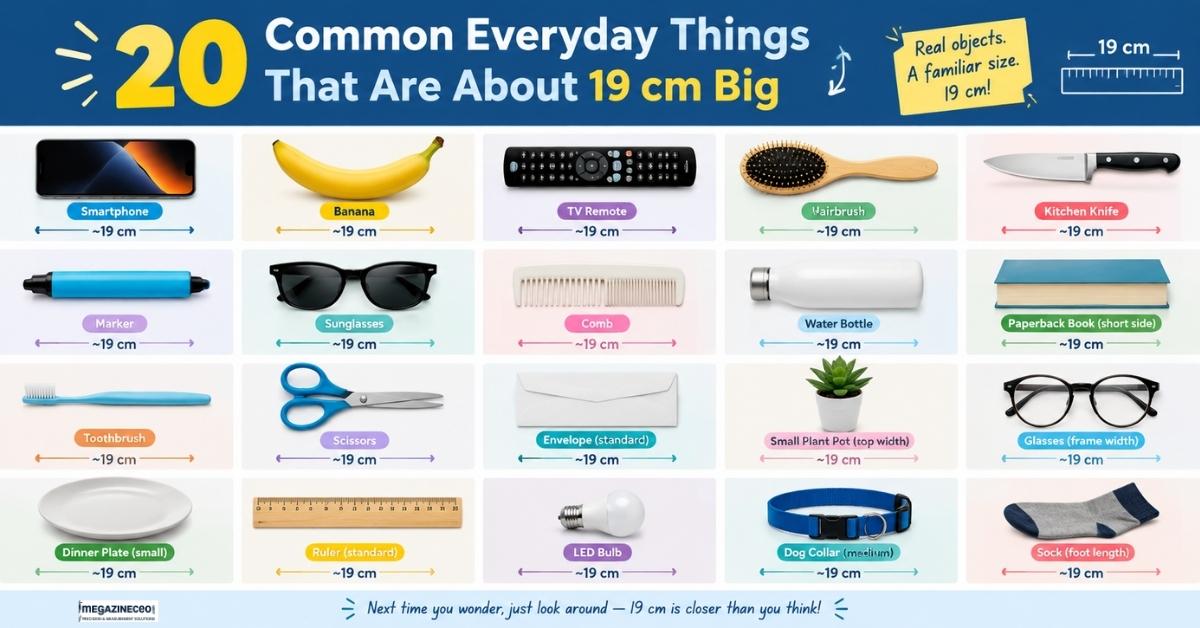
Have you ever looked at a product online and wondered how long 19 cm actually is? Numbers alone can be hard to picture, especially when you are shopping or checking an item’s size. The good news is that you don’t need a ruler to get a rough idea. Nineteen centimeters equals about 7.48 inches, or nearly seven and a half inches. A few familiar objects can help you imagine this length in real life.
Understanding 19 cm Big becomes much easier when you compare it with everyday items around your home. From hairbrushes and kitchen utensils to small household accessories, many objects can give you a useful visual reference. Their sizes may vary, so treat these examples as estimates rather than exact measurements. In this article, you’ll find 20 common everyday things that are about 19 cm long. These simple comparisons will help you picture the length and make better size estimates when shopping or measuring objects.
How big is 19 cm?
19 centimeters is just under 20 centimeters, making it a little shorter than one-fifth of a meter.
In imperial units, 19 cm to inches works out to approximately 7.48 inches, which is close to seven and a half inches.
Imagine a small household item resting across your palm.
Depending on your hand size, that length may extend from your wrist toward your fingertips, giving you a rough visual reference without measuring equipment.
19 cm in Different Units
Converting centimeters into other units makes it easier to understand product dimensions, especially when shopping on websites that use different measurement systems.
Here are the most useful conversions for 19 centimeters.
| Measurement unit | Equivalent |
| Centimeters | 19 cm |
| Inches | 7.48 inches |
| Millimeters | 190 mm |
| Meters | 0.19 m |
| Feet | 0.623 feet |
| Yards | 0.208 yards |
The conversion from centimeters to inches uses the exact relationship of 1 inch = 2.54 centimeters.
Dividing 19 by 2.54 gives approximately 7.4803 inches, which rounds to 7.48 inches.
Similarly, 19 cm to millimeters requires multiplying by 10, giving 190 millimeters.
If you encounter a product listing that says 190 mm, you’re looking at the same length as 19 cm.
What Does 19 cm Look Like?
The easiest way to understand what does 19 cm look like is to compare it with something familiar.
A large hairbrush, a compact kitchen utensil, or a small notebook may provide a useful starting point, depending on the item’s dimensions.
Picture a straight line measuring 19 centimeters on a desk.
It would be slightly shorter than a 20 cm ruler section and noticeably longer than a 15 cm section, making these comparisons useful for everyday measurement estimation.
Remember that an object’s overall height, width, and length are different measurements, so check which dimension you’re comparing.
Why Understanding 19 cm Matters
Recognizing 19 cm in real life can help when you’re choosing household accessories, arranging a desk, or deciding whether an item will fit inside a drawer.
It also makes online shopping easier when product dimensions appear in centimeters rather than inches.
For example, if a product description lists a length of 19 cm, you can picture an object around seven and a half inches long instead of guessing from the number alone.
That simple comparison can help you judge whether the item suits your available space.
Read More: 15 Common Everyday Things That Are About 39 Inches Long
20 Real-Life Examples of 19 cm (Simple & Daily Use)
The following everyday objects that are 19 cm long or tall offer practical visual references.
Some may measure close to 19 cm in one dimension, while others are available in sizes that vary considerably.
Before using an example for an important fit or purchase, check the manufacturer’s listed object dimensions or measure the item yourself.
The goal here is to build a useful sense of approximate length, not to claim that every version measures exactly 19 cm.
1. Hairbrush Length
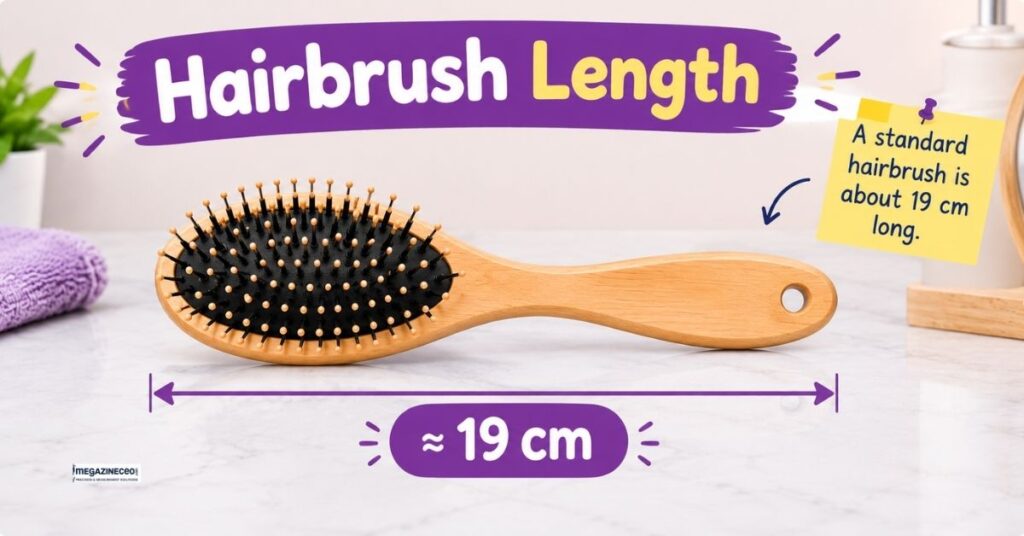
A compact hairbrush can measure around 19 cm from the tip of its handle to the opposite end of its head.
This makes it a convenient example when you’re looking for common objects about 19 cm long around the house.
Brushes come in many shapes, though, and paddle brushes can be considerably longer.
Measure the full brush rather than just its bristles if you want an accurate comparison.
2. A5 Notebook Height
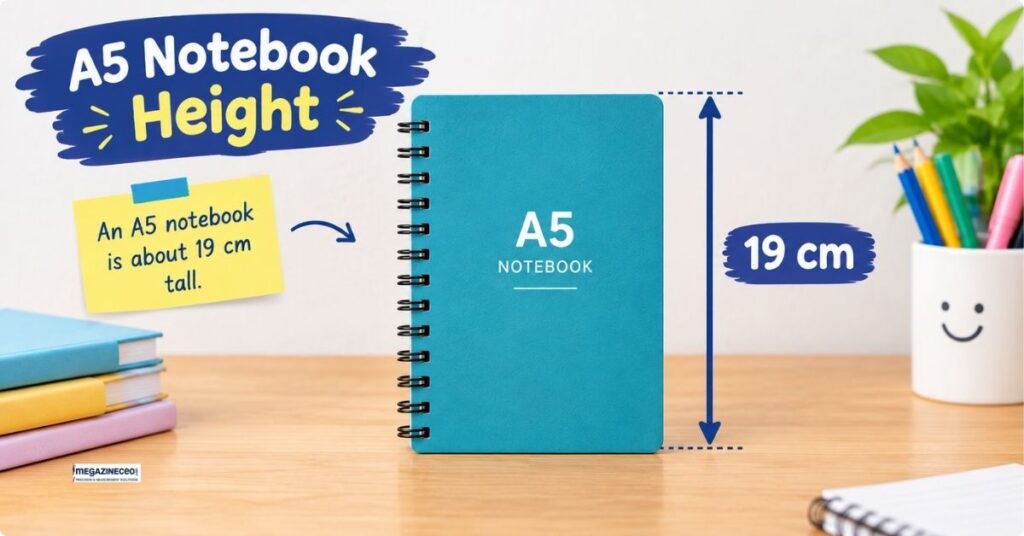
An A5 notebook is a useful reference for understanding compact stationery, but its standard height is actually 21 cm, not 19 cm.
That makes it about 2 cm taller than the measurement you’re trying to visualize.
A5 notebooks typically measure 14.8 × 21 cm when closed.
You can still use one as a nearby comparison, but don’t treat it as an exact 19 cm example.
3. Kitchen Spatula Length
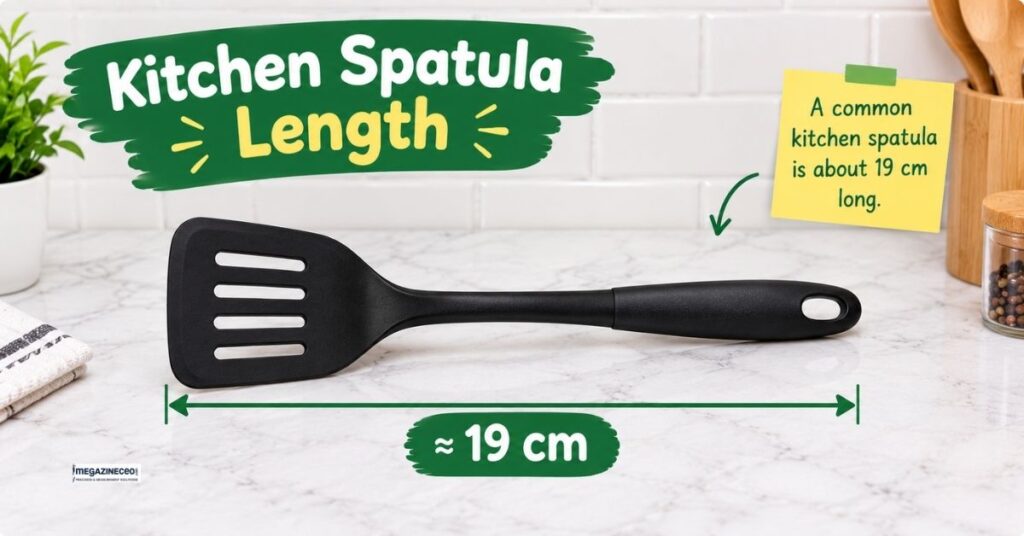
A compact kitchen spatula may measure close to 19 cm from the end of its handle to the tip of its blade.
This is especially true of smaller utensils designed for mixing ingredients in narrow bowls or preparing individual portions.
Larger spatulas often exceed this length, so the measurement depends on the design.
Check the overall length when comparing kitchen utensils rather than estimating from the blade alone.
4. TV Remote (Large Model)
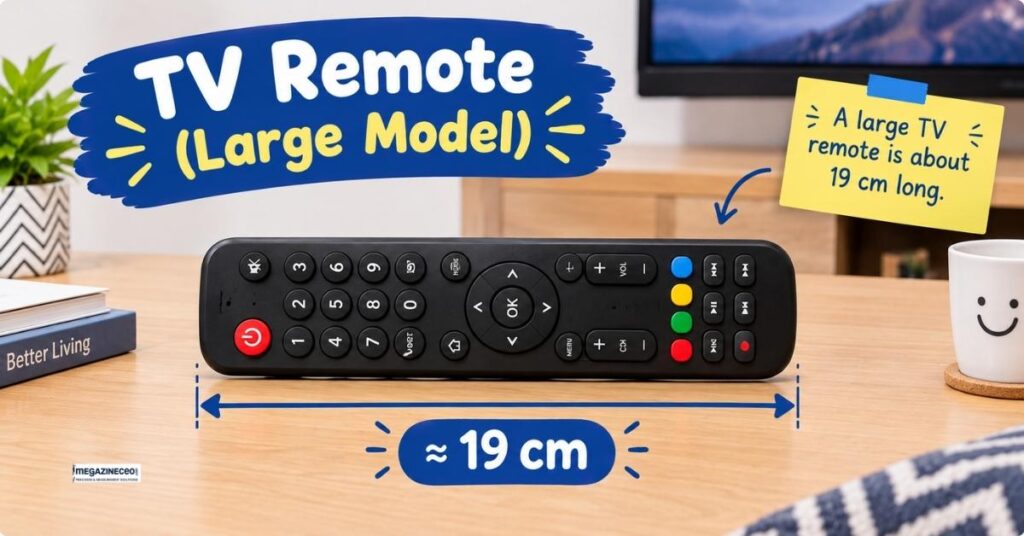
Some full-size TV remote controls approach 19 cm in length, providing a familiar example of an elongated household object.
Their narrow shape makes it easy to picture a length of roughly 7.48 inches.
However, many modern remotes are shorter, particularly compact streaming-device remotes.
If you have one at home, measure it from end to end before using it as a reference for 19 cm size comparison.
5. Reusable Water Bottle Height

A small reusable water bottle may stand around 19 cm tall, particularly when it holds a modest amount of liquid.
Its height can help you visualize this measurement while packing a lunch bag or arranging items on a shelf.
Bottle dimensions vary with capacity, shape, and lid design.
Remember to measure from the bottom to the highest point, including the lid if you need the bottle’s total height.
6. Cooking Spoon Length
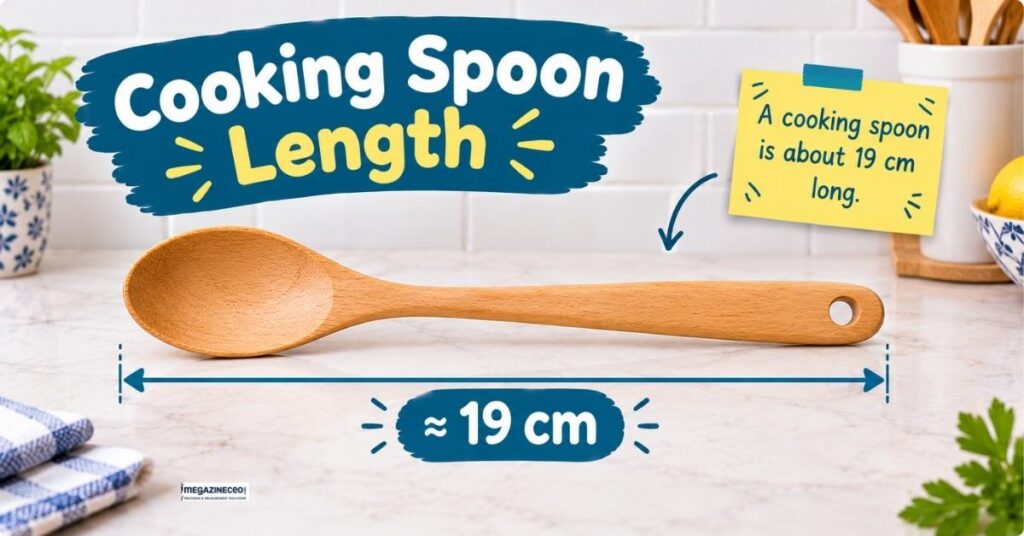
A short wooden cooking spoon can come close to 19 cm long.
You might find one among compact household items designed for small pots, serving dishes, or quick food preparation.
Traditional cooking spoons are often longer, so this comparison works best for smaller models.
Measure from the handle’s end to the tip of the spoon bowl to find its full length.
7. Small Flower Vase Height
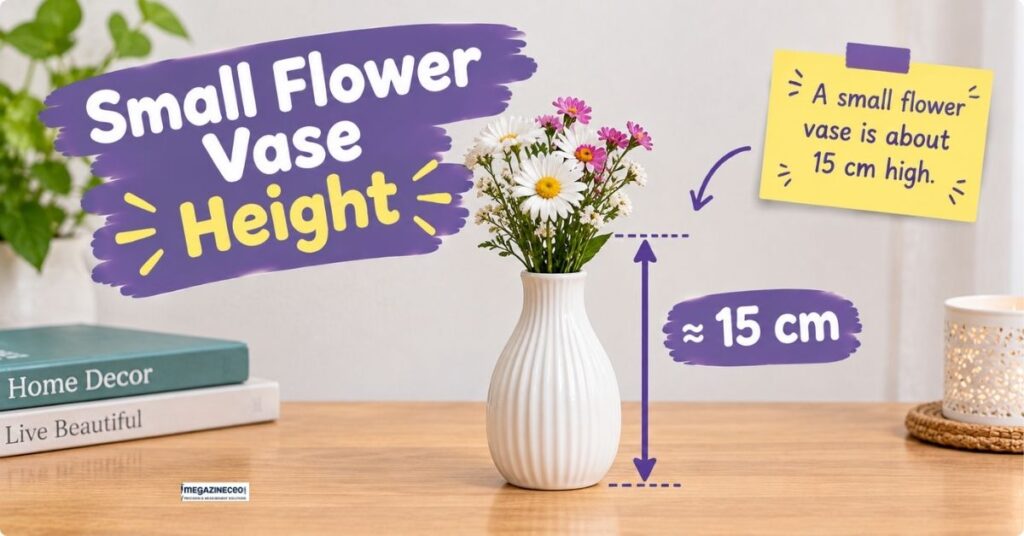
A small flower vase around 19 cm tall is a plausible example of this measurement.
It might sit on a bedside table, a narrow windowsill, or a small shelf without taking up too much vertical space.
Some vases are much shorter, while others stand considerably taller.
Use the vase’s total height as your reference, and remember that a wide vase can look larger than a narrow one of equal height.
8. Clipboard Width
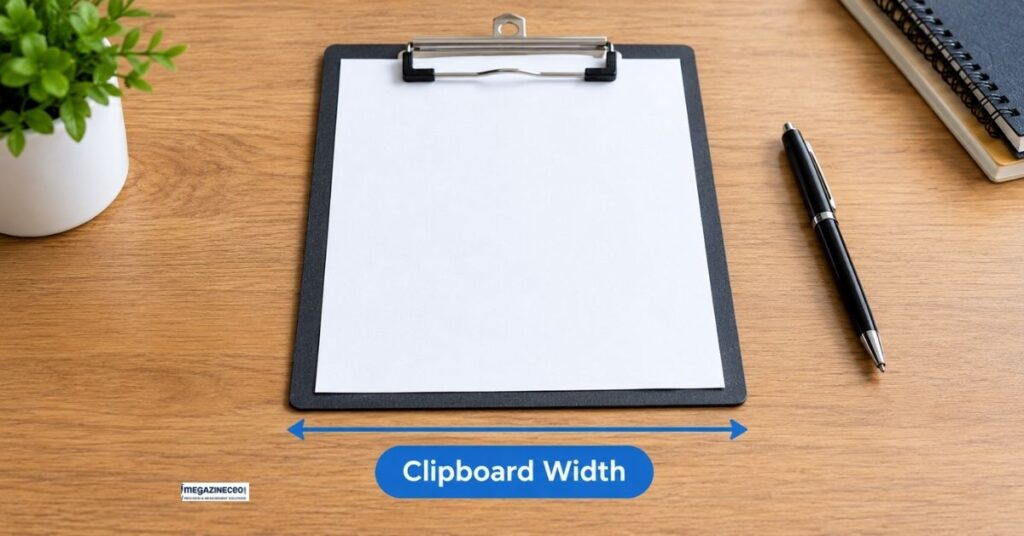
A compact clipboard may measure around 19 cm across its width, depending on the paper size it accommodates.
This can be a useful reference for stationery, especially if you regularly work with notes, checklists, or small forms.
Standard letter-size and A4 clipboards are usually wider than 19 cm.
For a reliable comparison, check the product’s width rather than assuming every clipboard has the same dimensions.
9. Tissue Box Length
A compact tissue box can have a length close to 19 cm.
Its rectangular shape makes it easier to compare with a straight line than an irregular object such as a curved brush.
Many tissue boxes are longer or shorter, depending on their capacity and design.
Measure the longest side of the box if you’re comparing its length with objects that measure 19 cm.
10. Small Desk Organizer
A small desk organizer may measure approximately 19 cm across or along its longest side.
This size can suit a compact workspace where you need somewhere to store pens, sticky notes, and other stationery items.
Organizers have different layouts, so their height, width, and depth can vary widely.
Check the specific dimension listed by the manufacturer before deciding whether one will fit your desk or drawer.
11. Compact Umbrella Handle
A folding umbrella may have a handle or folded section measuring close to 19 cm, depending on its design.
This gives you a practical reference when comparing compact travel accessories.
Be careful about which part you’re measuring.
A handle alone may be around this length, while the entire folded umbrella can be shorter or longer.
12. Small Cutting Board Width
A small cutting board measuring about 19 cm across is a useful example of a compact kitchen accessory.
It may work for slicing a lemon, chopping a small amount of herbs, or preparing a quick snack.
Larger boards provide more room for food preparation and can be considerably wider.
For accurate product dimensions, measure across the board’s width rather than its diagonal.
13. Medium Picture Frame Height
A compact picture frame may stand around 19 cm tall, particularly when designed for a tabletop or bedside display.
This gives you a recognizable household reference for a length of approximately 7.48 inches.
Frame dimensions depend on the photograph size and the surrounding border.
Check whether the listed measurement describes the frame’s outside dimensions or just the photograph it holds.
14. Hardcover Book Height
Some compact hardcover books measure close to 19 cm tall.
Their straight edges make them handy references when you’re comparing the height of an object with a familiar item.
However, book sizes vary considerably, and many standard hardcovers are taller than 19 cm.
Measure the book from its bottom edge to its top edge rather than relying on its thickness or cover design.
15. Kitchen Paper Towel Holder Base
The base of a paper towel holder may measure around 19 cm across, especially on some freestanding kitchen models.
This offers a useful comparison when you’re deciding how much counter space a household accessory might occupy.
Not every holder has a base this wide, and wall-mounted designs use a different arrangement.
Check the base diameter or width, since that dimension is more relevant than the holder’s total height.
16. Large Toothbrush
A long-handled toothbrush can serve as another visual reference, although many adult toothbrushes measure less than 19 cm.
Some models approach this length when you measure from the end of the handle to the tip of the bristles.
If you have a toothbrush nearby, use it to estimate the distance before checking with a ruler.
This is a simple way to practise length estimation using an object you probably see every day.
17. Large Smartphone
A large smartphone may measure around 19 cm diagonally, but its height is usually a different measurement.
This distinction matters because people sometimes confuse a screen’s advertised diagonal size with the phone’s actual length.
If you want to compare a phone with 19 cm, check its published height, width, and screen diagonal separately.
Only the dimension closest to 19 cm should count as a useful comparison.
18. Small Serving Tray
A compact serving tray may measure about 19 cm across its shorter side or along its length.
Small trays are useful for carrying a cup, serving a snack, or keeping everyday accessories together.
Tray dimensions vary considerably, so this is an example to check rather than an exact standard.
Measure one straight edge to compare it with your intended 19 cm measurement.
19. Compact Pencil Case
Some compact pencil cases measure close to 19 cm long.
They offer a practical stationery comparison because their rectangular shape makes the overall length easy to identify.
Other pencil cases are designed for longer pens, rulers, or extra supplies and may exceed this size.
If you’re buying one to fit a particular bag or drawer, check the stated length before ordering.
20. Small Kitchen Tongs
Short kitchen tongs can measure around 19 cm from one end to the other.
Their elongated shape makes them another example of an everyday utensil that can help you picture this length.
Many cooking tongs are considerably longer, especially those designed for grilling.
Choose a compact model if you want a close comparison, and measure the tool while it’s in its normal closed position.
19 cm in Daily Life
A length of 19 cm appears in different contexts, including stationery, kitchen equipment, personal accessories, and small household products.
Recognizing the measurement can help you estimate whether an object will fit on a shelf or inside a storage compartment.
For example, imagine ordering a desk organizer listed as 19 cm wide.
You can compare that figure with a familiar object before deciding whether the organizer will leave enough room for your other supplies.
How to Visualize 19 cm Without a Ruler
You don’t always need a metric ruler or measuring tape to make a rough estimate.
Start with a known reference, such as a ruler, a measured notebook, or a household object whose dimensions you’ve checked previously.
You can also try this simple approach:
- Find an object with a verified length close to 19 cm.
- Place it beside the item you want to estimate.
- Align one end of each object.
- Compare the opposite ends to see how closely they match.
Your hand can offer a rough visual reference, but hand sizes differ from person to person.
For better measurement estimation, check your hand span once with a ruler instead of assuming it matches a standard length.
Common Mistakes When Estimating 19 cm
One common mistake is treating an approximate example as an exact measurement.
A hairbrush or bottle may look close to 19 cm, but its dimensions can vary across brands and models.
Another mistake involves measuring the wrong side of an object.
For example, a book’s height is different from its width, and a picture frame’s outside height is different from its photo opening.
19 cm Compared to Other Measurements
Comparing nearby lengths can help you develop a more reliable sense of scale.
These everyday measurement comparisons also make metric and imperial conversions easier to remember.
| Measurement | Approximate inches | Difference from 19 cm |
| 10 cm | 3.94 inches | 9 cm shorter |
| 15 cm | 5.91 inches | 4 cm shorter |
| 19 cm | 7.48 inches | Reference length |
| 20 cm | 7.87 inches | 1 cm longer |
| 25 cm | 9.84 inches | 6 cm longer |
| 30 cm | 11.81 inches | 11 cm longer |
The comparison between 19 cm compared to 20 cm is particularly useful because the difference is just one centimeter.
That gap equals 10 millimeters, so a 20 cm object is slightly longer, but the difference may be difficult to spot without placing the objects side by side.
One important distinction: how long is 19 inches compared to an object is a different question from how long 19 cm is.
Nineteen inches equals 48.26 cm, making it more than twice as long as 19 cm.
Where Is 19 cm Commonly Used?
The metric system uses centimeters to describe the dimensions of smaller objects, including books, containers, kitchen accessories, and electronic devices.
You’ll often see measurements in centimeters when shopping online, comparing product sizes, or checking whether an item fits a particular space.
In countries that use inches more frequently, product listings may show both units or provide an inch measurement alone.
Understanding metric to imperial conversion helps you compare products without confusing centimeters with inches.
Importance of Accurate Measurement
A rough estimate is usually enough when you’re trying to visualize an everyday object.
However, accurate measurement matters when you’re choosing a storage container, fitting an accessory into a tight space, or checking whether a product matches its advertised dimensions.
Use a ruler for shorter objects and a measuring tape for larger or curved items.
Measure the specific side you need, and check whether the manufacturer’s dimensions include handles, lids, or other protruding parts.
Improve Your Measurement Skills
You can improve your measurement estimation by practising with familiar objects rather than relying on memory alone.
Choose three household items, measure their lengths, and compare each result with 19 cm.
Try estimating their dimensions before checking the measurements.
Over time, this exercise can help you recognize differences between 15 cm, 19 cm, and 20 cm more easily.
FAQs
How big is 19 cm in inches?
19 cm equals approximately 7.48 inches, or just under seven and a half inches.
The conversion uses the standard relationship of 2.54 centimeters per inch.
Is 19 cm considered a large measurement?
It depends on what you’re measuring.
For a small household accessory, 19 cm can be a moderate length, while it’s relatively short for furniture or larger appliances.
How can I estimate 19 cm without a ruler?
Compare the object with another item whose dimensions you’ve already measured.
A compact brush or small utensil might provide a useful reference, but verify its actual length before relying on it.
Is 19 cm used in everyday life?
Yes, centimeters commonly describe the dimensions of household products, stationery, kitchen tools, and personal accessories.
You’ll also encounter the measurement in online product descriptions and packaging specifications.
What everyday objects are about 19 cm long?
Depending on the model, examples can include compact hairbrushes, short cooking spoons, small water bottles, and folding umbrella handles.
Their actual dimensions vary, so check the specific item rather than assuming every example measures exactly 19 cm.
Conclusion
Understanding how 19 cm Big an object is becomes easier with everyday examples. 19 cm Big means about 7.48 inches, which is close to seven and a half inches. You can compare this length with a hairbrush, kitchen spatula, or compact water bottle. These items help you picture the size without a ruler. However, their actual measurements may vary by brand and design.
Knowing how 19 cm Big is can help when shopping online or checking product sizes. It can also help you choose items that fit your desk, drawer, or shelf. For exact results, use a ruler or measuring tape. Don’t rely only on visual estimates. Once you recognize 19 cm Big, comparing everyday objects becomes much simpler. Which household item helps you picture this length best? Share your example and help others understand this measurement t

Aaron Wells
Aaron Wells is a measurement content writer and researcher at Megazine CEO. He focuses on clear explanations of measurement units, conversions, calculations, and practical applications. His work emphasizes careful research, understandable language, and useful examples, helping readers build confidence when interpreting everyday and technical measurement information.